Buying Land for Building? What a Soil Test Can Tell You Before You Build
A site may have the ideal location, a suitable approach road, and sufficient room for your dream building. But what’s underneath can affect how that building should be designed—and what it may cost to construct.
Checking the site limits is important, but understanding the ground is just as important before you finalize your ideas.
By evaluating the soil before building, engineers may evaluate the layers of soil, its strength, how it will settle, and the conditions of the groundwater. These results are useful in foundation design and in assessing ground-related problems before construction. A soil nutrient test for agriculture will not provide you a foundation recommendation; you would need a geotechnical study for a construction evaluation.
What is soil testing for building purposes?
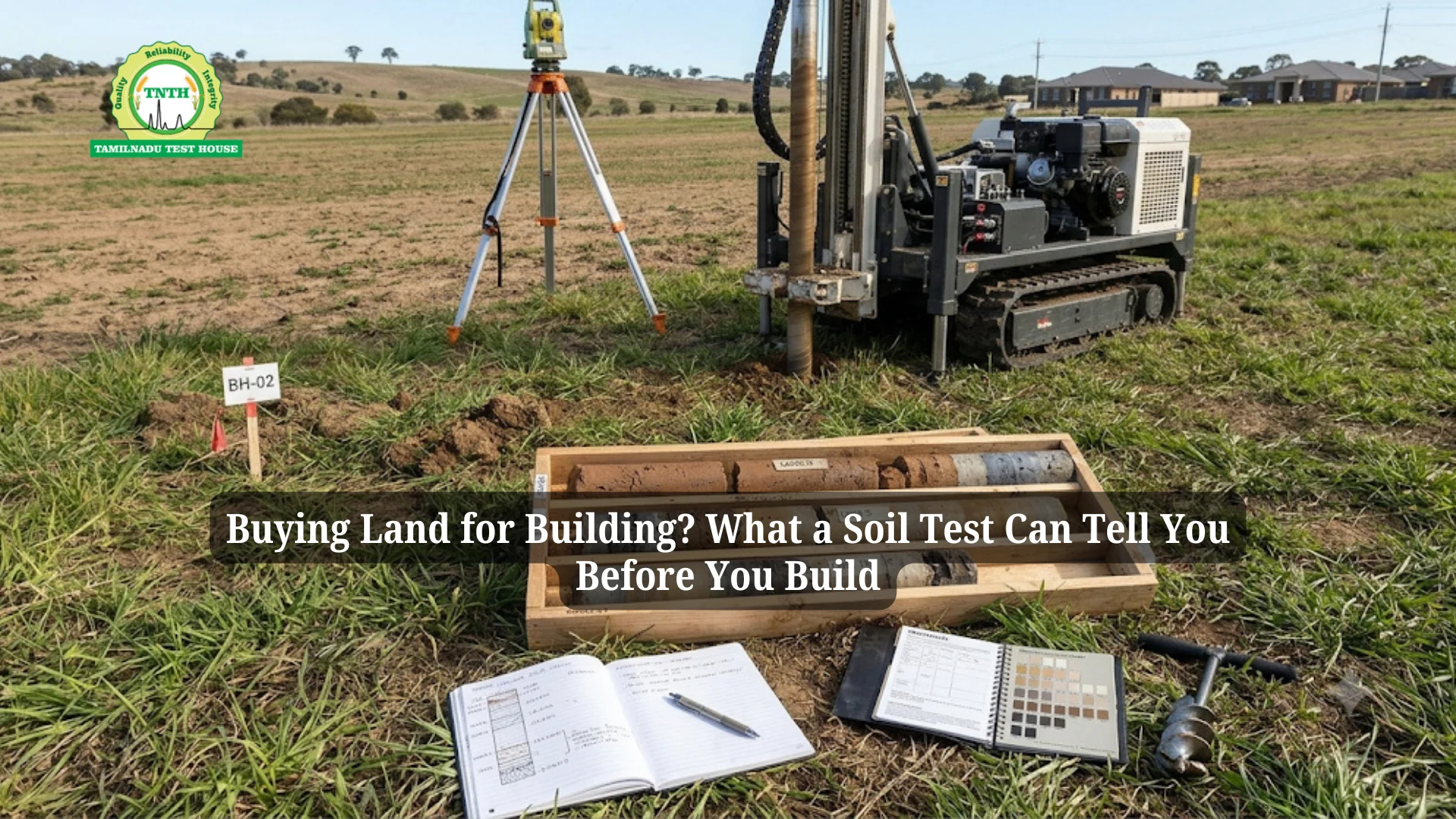
Geotechnical site investigation includes testing of construction soils. It uses information from the site, outdoor exploration, and chosen laboratory studies to determine how the ground would react under the planned building.
Depending on the project, the inquiry may include boreholes, soil sampling, field measurements, and engineering analysis.
The investigation should be planned considering the proposed structure, site conditions, and design criteria. Taking a surface sample without knowledge of its depth or place does not replace this technique.
What a Soil Investigation Can Tell You Before You Build?
1. Different soil layers under the ground surface
What you see when you visit a plot may not be what the soil looks like below.
At the places investigated, an investigation may reveal layers of sand, clay, silt, fill, or rock. Their thickness and qualities give engineers an understanding of the ground beneath the proposed foundations.
For example, a firm-looking surface material could have a weak layer underneath. This is one reason why a plan cannot be judged acceptable for a certain foundation by appearance alone.
2. The Ability of the Ground to Support Building Loads
The foundation transfers the building weight into the ground. The engineers require the right knowledge about the strength of the soil and the conditions of the ground to determine how this load can be supported.
The report may also provide suggestions for bearings based on certain foundation dimensions, depths, and assumptions.
The value for bearing capacity should be studied in conjunction with the whole report. This is not a blanket grade that instantly passes any structure on the lot.
3. Possible settlement
Ground can become compact under load. Engineers will look at how much the building is likely to sink and whether it might sink unevenly in different places.
Differential settling can induce cracking or deformation; however, there are various reasons for cracks.
Understanding settlement behavior allows the design team to evaluate foundation arrangements and the need to consider ground improvement or other measures.
4. Ground water conditions
Groundwater can affect the excavation, the construction procedures, and the behavior of the foundation.
Water found during an investigation might give significant information, but its level can alter with rainfall, seasons, and local conditions. One observation should not be taken as a permanent water level in the earth.
The engineer may recommend additional monitoring or water management techniques during construction where appropriate.
5. Soils Whose Nature Changes with Moisture
Some clay soils expand when they get wet and shrink when they dry. If such a behavior is suspected, adequate testing might help to analyze the problem.
The results may affect the foundation design, drainage arrangements, and moisture management techniques.
How the response plays out depends on the site and the building. There is no one foundation solution that works for every clay-soil plot.
6. Variable Ground/Fill
Land may have been raised or leveled with imported material. The fact that a plot seems level does not mean that the fill was laid and compacted properly.
Investigations can help detect variable ground and determine whether further assessment, removal, improvement, or a new foundation technique should be pursued.
The unusual history at the location may also warrant separate environmental testing.
What Tests Do They Run On Soil Before Construction?
The geotechnical engineer selects tests based on the site and project. Tests that may be done:
| Assessment or test | What it helps assess |
| Grain size measurements | Classification of soils and particle size distribution |
| Test for Moisture Content | Tested water sample |
| Atterberg limitations | Fine-grained soil properties in a plastic state |
| Shear strength test (8) | Resistance to shear under given conditions |
| Testing for consolidation | Compression behavior applicable to settlement assessment |
| Field penetration tests | Ground resistance that allows engineering interpretation |
Not all tests are needed on every site. Don’t choose a package based on the number of tests they have mentioned; ask for a project-specific inquiry scope.
Should you have the soil tested before you buy land?
Where practicable, seek professional guidance during purchasing due diligence, especially if the plot shows signs of fill, has a history of waterlogging, is uneven or has a former usage that raises concerns.
Permission from the landowner is needed to access the inquiry. Provide the engineer with any available information on the proposed building type and site.
If testing cannot be carried out before purchase, appreciate the residual uncertainty and provide for a suitable inquiry before final foundation design.
An adjacent building or some previous report from another plot does not impose constraints on your land.
What Impact Can Soil Testing Have on Building Costs?
Investigations can ascertain the factors influencing excavation, foundation depth, ground improvement, water management, and construction procedures.
This will assist the project team in putting together a better-informed budget. It does not guaranty that all subsurface conditions will be detected or that further costs will be avoided.
The cost of investigation varies with accessibility, depth of inquiry, equipment, testing, and reporting requirements. Compare quotations by scope and engineering deliverables, not just price.
Questions to ask the testing provider
Elucidate before assigning a supplier:
- The service includes field investigation and geotechnical interpretation?
- Who determines the number, location, and depths of boreholes?
- What details do we need regarding the proposed building?
- Will the report provide design specifications, recommendations, and limitations?
- Are there any observations of groundwater in?
- Which required tests are within the laboratory’s current accredited scope?
Agricultural testing asks different questions than environmental analysis or geotechnical investigation. Ensure that the provider’s capabilities align with your construction demand.
Common Questions
Can a soil test tell me how many stories I can build on?
Not on its own. The height of the building depends on the structural design, the foundation design, the ground conditions, and any planning regulations that may exist. A geotechnical report provides information to the design team; it does not recommend a floor count in itself.
Is agricultural soil testing good for building a house?
No . Nutrients, pH, and other growing conditions are the common things tested for in agriculture. Construction must be based on the understanding of engineering behavior backed by adequate geotechnical research.
Is a soil survey looking for contamination too?
No, not automatically. The scope for contamination evaluation should be independent and based on the historical land usage and suspected pollutants. Ensure that environmental sampling and chemical analysis are included.
Know the Terrain Before You Make Your Plans
A soil inquiry is how you turn preconceptions about a plot into information your engineers can use. Schedule it soon enough so that the results can inform the design and budgets.
When you reach out to Tamil Nadu Test House, describe if you require agricultural soil analysis, environmental testing, or a construction-related assessment. Check the services and testing scope that are available before sending samples or requesting work.