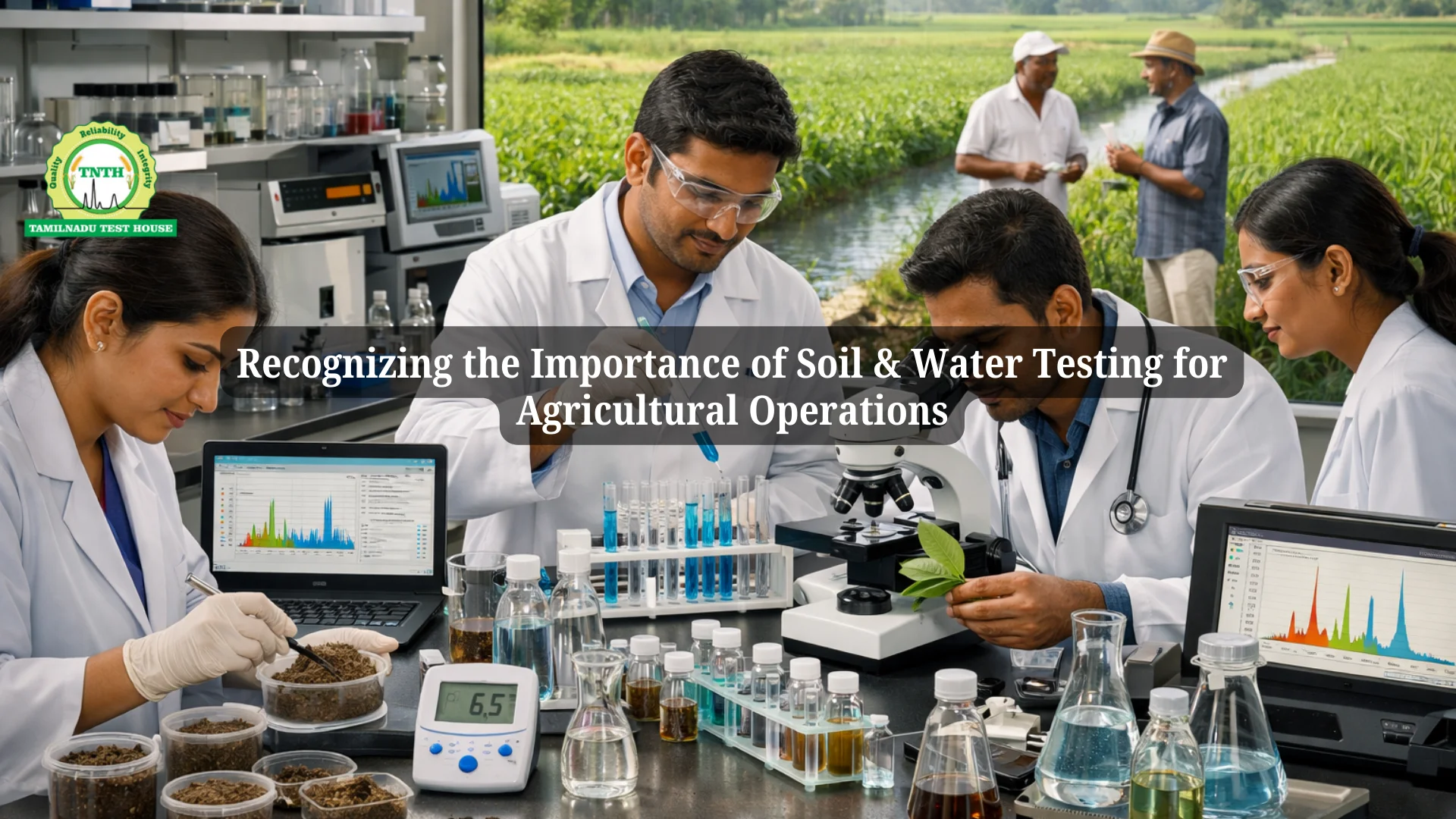
Recognizing the Importance of Soil & Water Testing for Agricultural Operations
Soil and water testing are essential agricultural practices that help farmers understand soil fertility, nutrient availability, pH levels, salinity, organic matter, and irrigation water quality. Laboratory analysis provides accurate data that supports better fertilizer management, crop selection, irrigation planning, and sustainable farming practices.
It is a comprehensive analysis of the physical, chemical, and biological properties of the soil. By examining nutrient levels, pH balance, and microbial activity, soil testing provides crucial information for farmers to make informed decisions required for their agricultural practices.
Many soil testing labs have been established to optimize crop yields, by analyzing soil contaminants like heavy metals or pollutants that might be a potential risk for consumption and the environment. Most of the soil testing labs in Chennai, like Tamil Nadu Test House, use precision testing to empower farmers to enhance their soil management practices, thereby optimizing crop yield and minimizing environmental impact.
Importance Of Water Testing:
Water is the essential component for any life on earth. The process of analysing the quality of irrigation water has become indispensable. It helps find potential contaminants that may affect the crop growth and human consumption. Agricultural runoff, industrial activities and natural sources of contamination can all contribute to water pollution. So, water testing has become evidently one of the essential steps in sustainable farming.
At majority water testing labs in Chennai, like TamilNadu Test House, we employ cutting-edge methodologies like chromatography and stringent quality control to assess water purity with unparalleled accuracy. These methods provide insights for farmers to ensure the health and vitality of their crops and communities.
Agriculture Testing For Crop Health:
In addition to soil and water testing, agriculture testing encompasses the analysis of feed,pests and disease pathogens. This holistic approach enables farmers to customise the nutritional supply and make precise adjustments in choosing the right fertilizer in farming.
Furthermore, agriculture testing also helps in identifying and diagnosing crop diseases, allowing farmers to take proactive measures to prevent outbreaks and reduce the reliance on chemical pesticides. On top of most agriculture testing lab in Chennai, we provide agriculture analysis to address the diverse needs of farmers, agribusinesses and regulatory agencies. From feed analysis to pesticide residue testing, we help identify challenges, diagnose diseases thereby implementing solutions through the agricultural supply chain.
When Should Farmers Test Soil and Water?
Regular soil and water testing helps farmers make informed decisions throughout the crop cycle. It is recommended to test:
Before planting a new crop to assess soil fertility and choose the right nutrient management plan.
Before fertilizer application to determine nutrient requirements and avoid over- or under-fertilization.
After harvesting to evaluate changes in soil health and prepare for the next growing season.
When crop growth or yield declines to identify possible nutrient deficiencies, salinity issues, or water quality problems.
Before using a new irrigation source to ensure the water is suitable for agricultural use and will not affect soil quality.
At least once every 1–3 years, depending on the cropping pattern, soil type, and farming intensity, to maintain long-term soil fertility and sustainable agricultural productivity.
Soil and Water Testing in Precision Agriculture
Modern farming increasingly relies on laboratory testing alongside precision agriculture technologies. Soil and water analysis helps farmers apply fertilizers and irrigation only where needed, improving resource efficiency, reducing waste, and supporting data-driven crop management. Laboratory reports can also complement field monitoring tools to optimize productivity and sustainability.
In conclusion, having a focus on promoting healthy soils, safeguarding water resources and nurturing crop health essentially needs the analysis for resilience and longevity of agricultural systems. At Tamil Nadu Test House, we make it our objective to promote a healthy and balanced ecosystem by providing services in soil, water and agricultural testing that helps assess nutrient deficiencies, monitor crop health and provides agricultural inputs. Our team of experts is dedicated to offer accurate, timely and actionable insights to support informed decision making and optimize agricultural practices.
Contact us today to learn more about our services and how we can help you optimize your farming practices to achieve bounteous yields.
FAQ’s
1. What parameters are tested in agricultural soil?
Common parameters include pH, electrical conductivity, nitrogen, phosphorus, potassium, organic carbon, micronutrients, and salinity.
2. Why should irrigation water be tested?
Water testing detects salinity, dissolved salts, pH, sodium, and contaminants that may affect crop growth and soil quality.