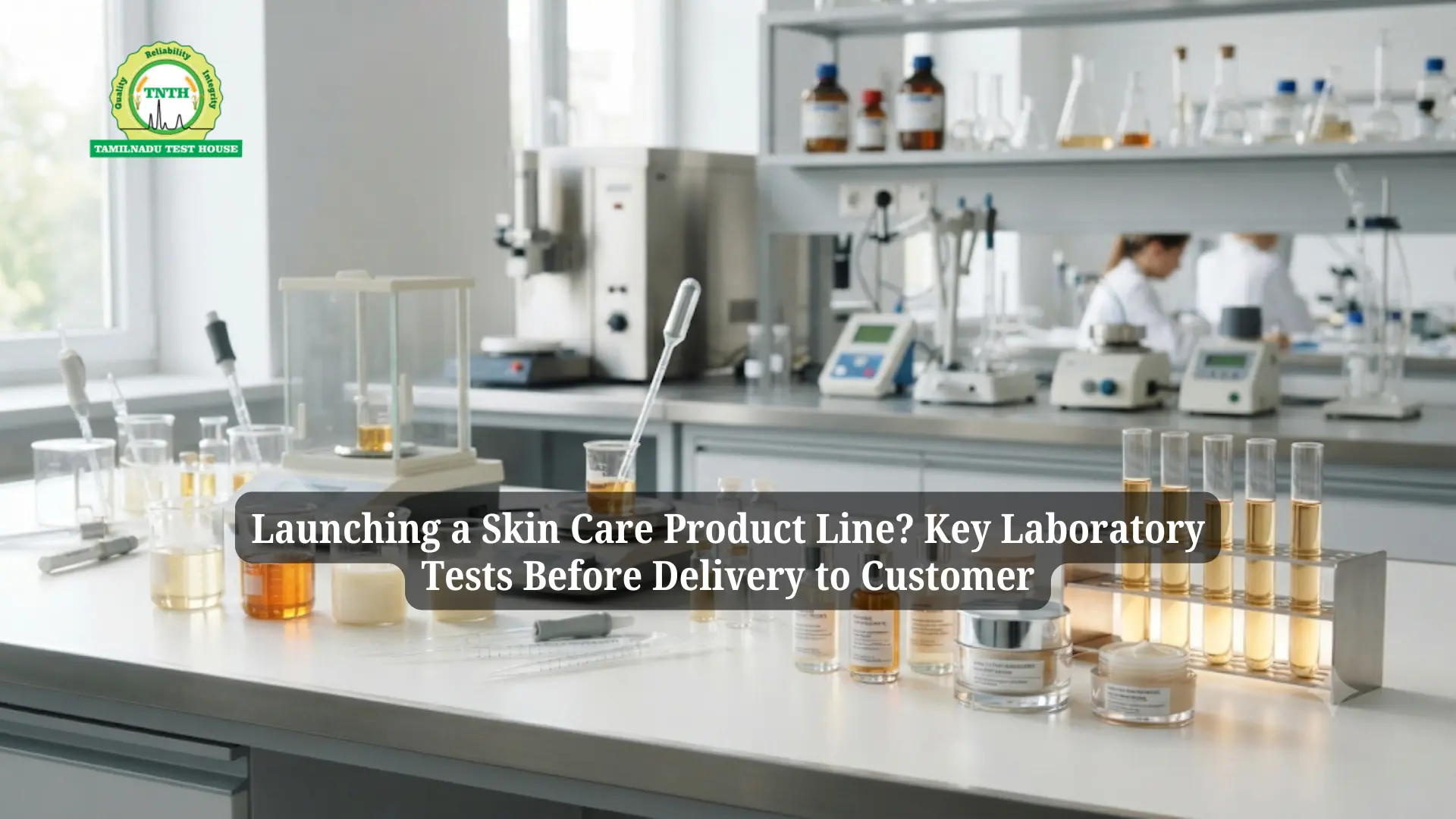
Launching a Skin Care Product Line? Key Laboratory Tests Before Delivery to Customer
Whether you’re an established cosmetic manufacturer or launching your first skincare line, choosing the right cosmetic testing services in Chennai can help you identify which tests your product needs before it reaches customers.
What laboratory tests should skincare products undergo before launch?
Common pre-launch tests include microbial quality testing, stability testing, and packaging compatibility testing. Depending on the formula, a lab may also check pH and viscosity. For water-based products that rely on preservatives, a preservative efficacy test helps assess how well the formula controls microbial growth. Sunscreens need separate testing to support SPF and UVA protection claims.
Why You Should Test Your Skincare Product in a Lab Before You Launch
Skincare formulations include a wide range of elements, such as active agents, preservatives, emulsifiers, perfumes, botanical extracts, and essential oils. Each ingredient has its job, but how ingredients interact with each other can affect the quality, stability, and performance of the final product.
“Producers may face problems such as: without proper laboratory testing
- Contamination with germs in processing or storage.
- Changes in the product’s color, texture, smell, or consistency.
- Separation of ingredients in creams and lotions.
- Contamination with unwanted heavy metals.
- Concentrations of chemicals in varying amounts.
- Instability of the storage formulation.
- Insufficient performance of the preservative.
Lab testing helps detect these faults before products reach the customer. It also helps to improve formulation, product development, and manufacturing quality assurance.
7 Types of Lab Tests Every Skincare Brand Should Know
1. Cosmetics—Microbiological testing
One of the most important evaluations for skincare products, particularly water-based formulations, is microbiological testing. Hygiene and preservation during manufacture are not enough in creams, lotions, gels, and cleansers and may even stimulate bacteria growth.
Microbiological testing of cosmetics is performed to determine:
It helps detect unwanted bacteria, yeast, and mold, which can impact product quality and safety.
The routine microbiological tests are
- Total aerobic bacterial count.
- Total yeast and mold count.
- Identification of specific micro-organisms, e.g., Staphylococcus aureus
- Pseudomonas aeruginosa detection.
- Detection of Escherichia coli and Candida albicans if any.
This helps manufacturers determine whether their formulations meet the microbiological quality requirements for their specific applications.
For new products, cosmetic brands should consider microbiological testing as part of the overall safety and quality assessment of product safety.
Check out Cosmetic Microbiology Testing at Tamil Nadu Test House.
2. Test of preservative efficacy
Skincare products require preservatives to protect them against microbial contamination. They prevent bacteria from forming in the product as it is being stored and used.
But just because a formulation has a preservative doesn’t mean it will be effective at giving protection.
What is preservative efficacy testing in cosmetics?
Preservative efficacy testing (sometimes called challenge testing) is an in vitro test that measures the ability of a product’s preservative system to prevent the growth of certain microorganisms added to the product under specific conditions.
This judgment is of special importance to:
- Facial washes and cleansers
- Creams for moisturizing
- Body butter.
- Sunscreen preparations.
- Water-based gels & serums.
The data help companies determine whether their preservation technology provides adequate protection throughout the product life cycle.
3. Testing Beauty Products for Toxic Metals
Heavy metal contamination is a serious issue in cosmetics development. Some raw materials, pigments, mineral additives, and plant extracts might add trace levels of undesirable metals to finished products.
Heavy metals to test for in cosmetics
Metals manufacturers may consider, depending on the formulation and risk assessment
- Lead.
- Arsenic
- Mercury
- Cadmium.
Some clarification might be helpful, especially in the list structure and terminology. There is also an inconsistency in formatting, such as capitalization of headings and bullet points. Here is a corrected paragraph that enhances clarity and consistency without changing the original meaning:
Heavy Metals to Test for in Skin Care Products
The metals manufacturers should consider testing for the following, depending on the formulation and risk assessment:
- Lead
- Arsenic
- Mercury
- Cadmium
- Nickel
- Chrome
Modern analytical techniques, including Inductively Coupled Plasma Mass Spectrometry (ICP-MS), allow for sensitive trace-metal analysis. Testing for heavy metals is important in both raw materials and final cosmetic products to detect any undesired contamination. This testing also helps to ensure quality and regulatory compliance.
4. Stability Testing of Formulations for Skin Care
When a skincare product is first formulated, it may seem amazing, but over time its properties can change owing to environmental influences like temperature and light.
Why Is Pre-Launch Cosmetics Stability Testing Important?
Stability testing is the capacity of a skincare formulation to keep its physical and chemical qualities under certain storage conditions. Key parameters are
- Appearance & Color
- Odour and scent
- pH level
- Viscosity and consistency
- Phase separation
- Alterations in texture and physical appearance
Accelerated stability studies are conducted to study the product under controlled settings. Real-time stability studies give information about the changes occurring during actual storage over time.
5. Active substances and chemical analysis
Today’s skin care solutions typically have active ingredients that target a specific cosmetic goal. The maker shall formulate to contain the desired elements in appropriate amounts.”
Typical ingredients in skin care products are
- Niacinamide (Vitamin B3)
- Sodium Hyaluronate;
- Vitamin C derivatives.
- Salicylic acid.
- Glycolic acid
- Retinoids & Retinol.
- Plant extracts, useful compounds from other
How do labs evaluate skin-care products for active ingredients?
Chemical analysis to identify individual chemicals of a cosmetic product and, if appropriate, to quantify them.
The analytical techniques employed, such as High-Performance Liquid Chromatography (HPLC) or Gas Chromatography-Mass Spectrometry (GC-MS), will be determined by the chemical properties of the molecules of interest.
These tests are used to check the formulation, ingredient quality, and batch uniformity during manufacture.
6. Testing of SPF and sunscreen
There is a need for more reviews of sunscreen products as the manufacturers make explicit claims about protection from UV radiation.
What testing is required for sunscreen products?
Sunscreen testing can include: Depending on the planned composition and claims:
- Test de FPS.
- Test for UVA protection.
- Water resistance test, where necessary.
- “Stability testing.
- Test de laboratoire.
- Chemical analysis as appropriate.
SPF testing is a standard way to determine the product’s sun protection factor. Product claims must be substantiated by suitable testing, such as water resistance and UVA testing.
Sunscreens should be marketed based on acceptable testing procedures and evidence to support the manufacturers’ claims.
What Tests Should Different Skincare Products Undergo in Labs?
Not every skincare product needs the same testing program. The tests to be performed depend on the formulation, the substance, the intended use, and the product’s claims.
| Skincare product | Important testing factors |
| Face creams and moisturizers | Microbiology, preservative efficacy, stability, and pH |
| Sunscreens | SPF, relevant UVA testing, stability and microbiology |
| Face washes | Microbial limits, pH, and stability |
| Body lotions | Microbiology, preservative efficacy, and stability |
| Anti-acne products | Active ingredient analysis, microbiology, and stability |
| Herbal skincare products | Microbiology, heavy metals, and relevant chemical analysis |
A lab can help a company design a testing plan that meets the company’s product standards and regulatory requirements.
Cosmetics—Requirements and Regulations in India
In India, cosmetic items are regulated under the Drugs and Cosmetics Act, 1940, and Cosmetics Rules, 2020, along with revisions and standards.
Manufacturers should establish the criteria for cosmetic ingredients, product quality, safety, labelling, and production procedures.
Further, Bureau of Indian Standards (BIS) standards may also cover certain cosmetic products and testing requirements.
Companies can obtain reliable analytical data to assess quality and create regulatory documentation in collaboration with a well-known cosmetic testing lab.
Cosmetic Testing Laboratory Chennai – How to Use?
Instead of a large testing package, use appropriate test processes based on the product category and related needs.
The selection of a good laboratory is a highly essential decision for makers of skin care products, particularly when they are getting ready to introduce a new product to the market.
Things to Consider in Selecting a Testing Partner:
- Testing Capabilities: Make sure the lab has the equipment to perform microbiological, chemical, heavy metal, and other required cosmetic tests.
- NABL Accreditation: Ensure that the lab is NABL accredited and the tests you seek are within its accredited scope.
- Analytical Tools: The analyses you need depend on the availability of adequate equipment and testing methodologies.
- Industry Experience: Look for labs with experience in testing personal care and cosmetic goods.
- Clear Reporting: Choose a lab that provides clear, easy-to-understand reporting on the analytical results.
A reliable lab partner can allow organizations to check the quality of the product and discover formulation concerns before the product is launched in the market.
Run Your Skincare Through Its Phases Before Going to Market
Tamil Nadu Test House (TNTH) Personal Care and Cosmetic Testing Services assists the producers in evaluating important product quality and safety aspects through proper laboratory testing.
Whether you are developing a new face cream, launching a skincare serum, manufacturing herbal cosmetics, or launching a sunscreen formulation, choosing the correct testing partner will improve your product development and quality assurance process.
Searching for a dependable cosmetic testing lab in Chennai? For testing requirements discussion, contact the Tamil Nadu Test Houses of your skincare products.
Personal Care & Cosmetics – Tamil Nadu Test House
Phone: +91 44 4794 9532
Email: [email protected]
FAQ: Testing skincare products
1. There are some tests that need to be done for the marketing of a skincare product.
Tests often include microbiological testing, preservative efficacy testing, heavy metal analysis, stability testing, pH testing, and active ingredient analysis. Sunscreen products may require testing for SPF and UVA protection.
2. How to know if the face cream is safe to use?
It should be assessed for microbiology, stability, pH, and preservation, if needed. Additional chemical and contaminant testing may be required depending on mix and contents.
3. Are Cosmetic Products Required to Be Heavy Metal Tested?
Heavy metal testing is used to discover unwanted trace metals such as lead, arsenic, mercury, and cadmium. It is useful to examine the quality of the raw materials and to analyse