
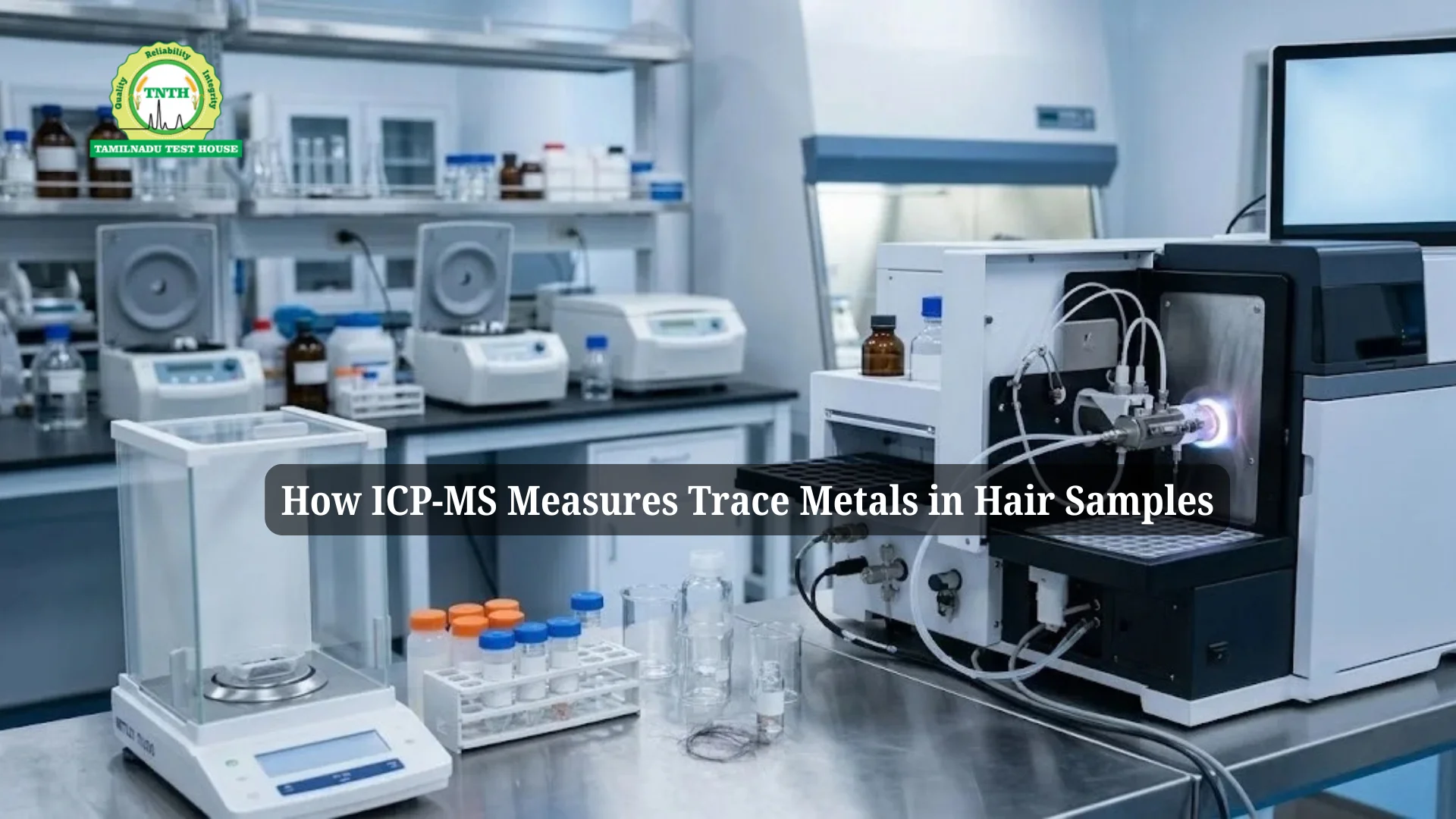
How ICP-MS Measures Trace Metals in Hair Samples
Hair may retain materials linked to the body or deposited through environmental exposure. Some metals are present in very low amounts, and analysing them requires a sensitive, precisely controlled procedure. Trace levels of a number of metals can be detected and quantified by Inductively Coupled Plasma Mass Spectrometry (ICP-MS).
ICP-MS hair elemental analysis combines controlled sample preparation, high-temperature ionization, and mass-based detection. It supports research, environmental studies and occupational monitoring. Results need context because hair can also accumulate metals from dust, water and cosmetic treatments.
Why Hair Samples for Elemental Analysis?
Hair is easy to collect, transport and store. Sampling is usually non-invasive. A modest quantity may suffice for multi-element testing. Because hair grows slowly, it can record elements over time.
But results don’t immediately tell you when exposure occurred, how a substance got into the body or whether it had a health effect. Sampling location, hair length, cosmetic procedures, and external contamination are factors to address.
Step 1: Take a Representative Sample
Hair is often trimmed close to the scalp using clean instruments and stored in a labelled container. Lab instructions may state the required amount, the area to be sampled and provide information on colours, bleaches or medicated shampoos.
Poor handling may introduce metal from tools, containers, or the environment. Identification and documentation provide sample traceability.
Step 2: Washing & Preparing the Hair
A major problem in hair trace metal testing is distinguishing between elements embedded in the hair and material adhered to the surface. Dust, sweat, hard water, workplace particles, and cosmetic products can alter the results.
A well-defined washing method removes surface contamination with minimal loss of elements associated with the hair. The sample is then dried and weighed. Washing affects results; therefore, use an approved approach consistently.
Step 3: Digestion of the Sample
Solid hair must be converted into a liquid solution. A weighed sample is treated with high-purity acids, typically using microwave digestion, to break down the organic matrix and release the elements.
Careful management of reagents, vessels and laboratory conditions is necessary. Blanks indicate contamination during preparation. Reference materials and fortified samples help monitor recovery and procedure performance.
Step 4: Generation of Ions in the Plasma
A nebuliser converts the digested and diluted solution into a fine aerosol and feeds it into a high-temperature argon plasma.
The sample is desolvated, atomised, and ionised, converting the elements in the sample into charged particles that can be sorted by mass-to-charge ratio.
Step 5: Separation and Detection of Trace Metals
Ions flow through the interface and ion optics of the instrument to the mass analyser. The detector then detects signals from specified isotopes.
The signals are compared with calibration standards of known concentration to determine the amount present. Using ICP-MS, elements such as lead, arsenic, cadmium, mercury, chromium, nickel, copper and zinc can be measured in a single run, subject to the validated scope.
Some isotopes are affected by spectral interferences. Correction methods, suitable isotope selection, and collision or reaction cell technology can improve accuracy.
Hair Mineral Analysis Quality Control Using ICP-MS
Reliable testing includes calibration verification, blanks, duplicates, spiked samples, and certified reference materials. Laboratories also monitor detection limits, recovery, precision, and instrument drift.
Method validation is particularly critical, as hair includes a complex chemical matrix, and anticipated concentrations can vary significantly. Laboratories should establish suitable limits of detection and quantification for each target element. Routine maintenance, clean preparation spaces, and analyst proficiency further reduce the likelihood of false elevation, signal suppression, or inconsistent reporting.
Final concentrations can be expressed as micrograms per gram and account for dilution and sample weight. Reports should detail the technique, elements and reporting limits.
What Affects Hair Test Results?
The elemental profile can be affected by several factors:
- Hair colouring, bleaching and chemical treatments
- Personal care products and anti-dandruff shampoos
- Dust, soil, water and occupational exposure
- Distance from the scalp and sampling location
- Washing, digestion and analytical methods
- Limited sample amount or improper storage
Therefore, interpret hair trace metal test results according to the sample history, exposure information, and the goal of the investigation. Hair analysis should not be regarded as a sole medical diagnosis. Where health concerns are present, a qualified healthcare professional should interpret the results and, where applicable, support them with clinical tests.
Conclusion
ICP-MS detects trace metals through controlled collection, washing, acid digestion, plasma ionisation, mass separation, calibration, and quality control. Proper analysis requires validated processes and contamination control.
Choose a facility with the right instrumentation, experienced analysts and documented quality practices for reliable hair elemental analysis by ICP-MS. Please contact our laboratory team for sample requirements, target elements, detection limits and the most appropriate testing scope for your application.