
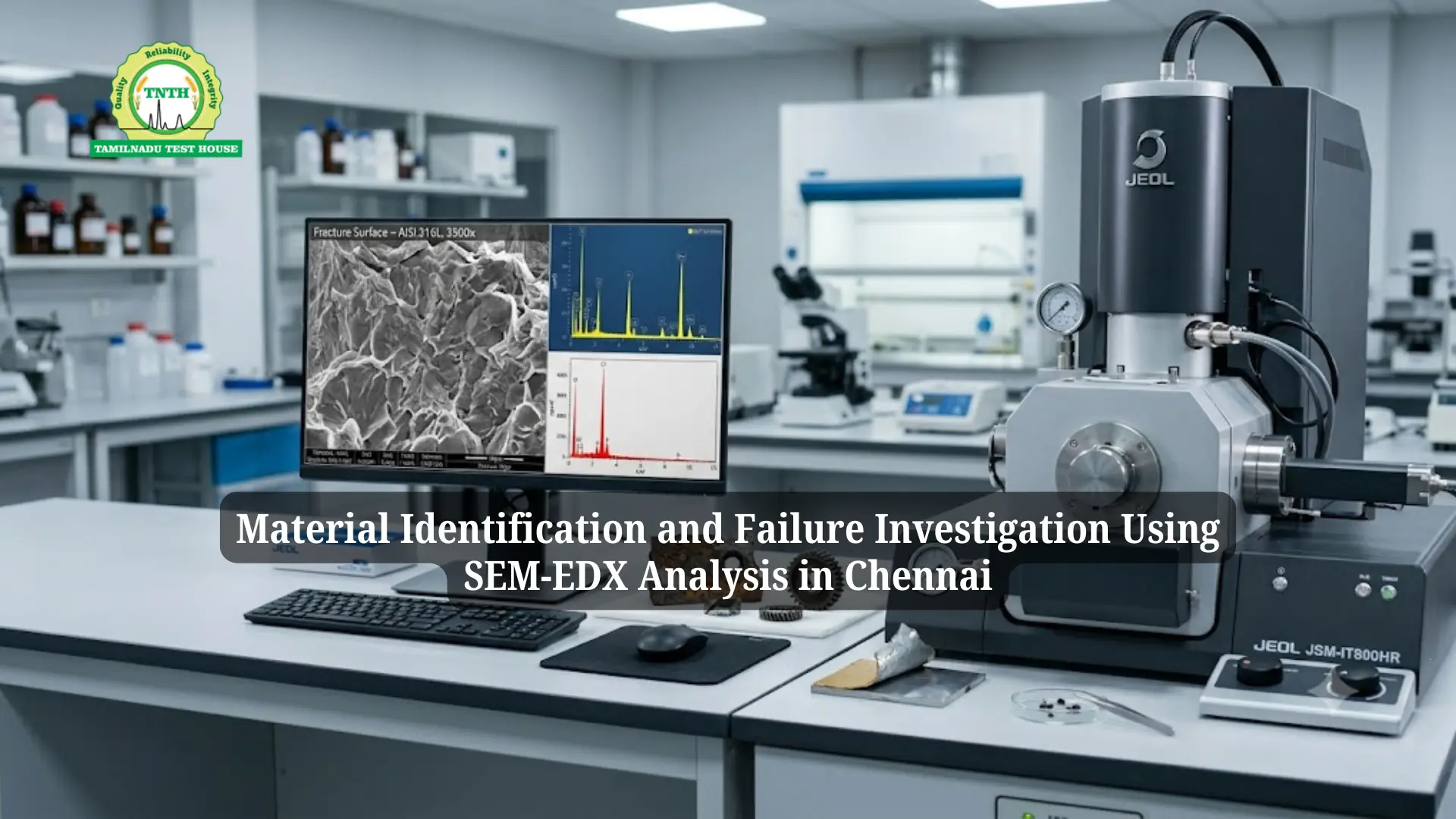
Material Identification and Failure Investigation Using SEM-EDX Analysis in Chennai
When a coating starts peeling, a component develops an unexpected crack, or a small particle appears on a finished product, looking at it under a normal microscope may not be enough to understand what happened.
In these cases, the SEM-EDX analysis can provide some visual and elemental information about the material. Scanning Electron Microscopy (microscopy analysis) allows obtaining detailed images of the surface of the sample, and Energy Dispersive X-ray Spectroscopy (EDX) allows identifying the elements present in the area of interest.
If you are looking for SEM-EDX analysis in Chennai, begin with the problem explanation and the affected area. This way the lab can decide what to look at and if sample preparation is needed.
This is an acronym for Scanning Electron Microscopy-Electron Dispersive X-ray Analysis. This technique is used to determine the chemical composition of materials and relies on the detection of X-rays emitted from a sample when it is irradiated by an electron beam.
The techniques are often combined when a material is to be investigated in more detail.
SEM (Scanning Electron Microscopy) gives images of the surface of a material at high magnification. It can show features such as cracks, pits, particles, deposits on the surface and changes in surface texture that are not visible to the traditional microscope.
EDX (Energy Dispersive X-ray Spectroscopy) gives information about the elements present in the chosen area of the sample. This is useful when the laboratory needs to know if a particle, deposit, or damaged area is made up of elements different from the surrounding material.
Using the two techniques together gives a clearer picture of a problem. SEM shows what the area looks like, and EDX provides information about what it contains.
When is SEM-EDX helpful?
The can be useful in several types of material investigations, especially if the source of a defect is not clear immediately.
Foreign Particles and Contaminants
A small particle on a product could come from the manufacturing process, equipment, packaging, or the surrounding environment. High-resolution surface imaging can show its physical characteristics, while EDX can help determine its elemental makeup.
Corrosion and Surface Deposits
Corrosion products or deposits can be examined to understand their composition. Comparing an affected area with an unaffected area can also help identify differences on the surface.
Problems with coating
Peeling, cracking, blistering, or unusual deposits on a coating may suggest that a more detailed examination is required. The damaged surface can be examined using electron microscopy, and Energy Dispersive X-ray Spectroscopy (EDX) can be used for the elemental composition comparison of different areas of the coating.
Component Failure
When a component breaks unexpectedly, the fracture surface may contain useful evidence. Fracture surface examination can reveal features associated with the failure, and EDX can help investigate particles, deposits, or other material present around the failed area.
Material Comparison
If two materials are expected to be similar but behave differently, The combined analysis can be used to examine selected areas and compare their surface features and elemental composition.
What Information Should You Provide to the Laboratory?
Give the laboratory some background on the sample. A cracked component, for example, is easier to investigate when the team knows where it was used, when it failed, and what happened before the failure.
Instead of sending a sample with only a request for a magnified image, explain what you are trying to find out.
For example:
- What material is being tested?
- Where was the sample collected?
- What problem was observed?
- When did the problem occur?
- Is there an unaffected or reference sample available?
- Which area of the sample is important?
- Are you trying to identify contamination, corrosion, a coating defect, or another issue?
Even a short background note can help the laboratory focus the examination on the right area.
What Type of Samples Can Be Submitted?
The suitable sample depends on the problem being investigated.
| Investigation | Possible Sample |
| Unknown particle | Particle or deposit collected from the product |
| Component failure | Failed part or a section containing the affected area |
| Coating defect | Coated material containing the damaged region |
| Corrosion | Corroded surface, deposit, or affected component |
| Material comparison | Suspected material along with a known reference sample |
Before sending a sample, it is advisable to discuss the sample dimensions, condition, and test requirement with the laboratory. Some samples may require preparation before they can be examined.
Why Is the Area of Interest Important?
There can be several different regions in the sample, but not all areas may be relevant to the investigation.
For instance, if a product has a visible deposit, the deposit may be more important than the clean surface around it. Similarly, the fracture region of a failed component may be more informative than an undamaged section.
The laboratory can study the part of the sample that is of interest to the investigation, provided that the area of interest is clearly identified.
Testing a Reference Sample?
“Yes. The provision of a known or unaffected sample can be useful where the purpose of the test is comparison.
If one batch of material is showing a defect and another batch is performing normally, for example, testing samples from both can help determine differences between them.
The same approach can be useful for:
- Defective vs. non-defective material
- Corroded vs. unaffected surface
- Suspected contamination vs. clean surface
- Failed vs. unused component
The comparison should be planned according to the question the investigation is trying to answer.
What Can the Analysis Report Tell You?
Depending on the agreed test scope, the report may include electron micrographs of the areas examined and EDX results showing the elements detected there.
The results can help with questions such as
- What does the damaged or unusual area look like at high magnification?
- Is a foreign particle present?
- Which elements are detected in the selected area?
- Does the composition differ between two regions?
- Are particular elements associated with a deposit or defect?
The findings should be interpreted alongside the sample history and the actual failure or contamination problem. Elemental results alone may not explain the complete cause of a failure.
How to send a sample for SEM-EDX analysis in Chennai
Please keep in mind the following before submitting the sample:
1. Clearly state the problem
What happened and what you want the test to find out.
2. Find the Important Area
Indicate or describe the location of the defect, particle, crack or deposit.
3. Don’t Handle Unnecessarily:
Carefully handle the sample so as not to contaminate the area under investigation.
4. Where Appropriate, Offer a Reference Sample
Including a comparison sample can make the investigation more meaningful.
5. Provide Previous Test Results (If Applicable)
Previous observations, photographs, or test results can provide useful background information.
6. Discuss the Test Requirement Before Submission
The laboratory can advise whether the sample is suitable and whether any preparation is required.
SEM-EDX Analytical Services in Chennai
More often than not, the problem of an unknown particle, a damaged coating, or a failed component needs a closer look. The surface imaging and elemental analysis results can be used to support the investigation.
For SEM-EDX testing at Tamil Nadu Test House, share your sample details, photographs of the affected area, and a brief description of what happened. The laboratory can then discuss sample suitability, preparation, and the scope of testing.
Frequently Asked Questions
What is SEM-EDX used for?
SEM-EDX is used for studying the surface features of materials and elemental information from selected areas. It is widely used for material identification, contamination studies, coating defects, corrosion investigations, and failure analysis.
What is the difference between SEM and EDX?
SEM is mainly used to image the surface of a sample in great detail. EDX gives details of the elements detected in a selected region. The two techniques are often used in combination, as the surface images can be assessed together with the elemental results from EDX.
Can SEM-EDX identify an unknown particle?
It can give valuable information on an unknown particle, such as its appearance and the elements present in it. The final interpretation depends on the sample, particle size, test conditions, and other available information.
Can a failed component be examined using SEM-EDX?
Yeah. View selected areas of a failed component, such as fracture or damaged areas. SEM can reveal surface features, and EDX can provide elemental info from selected locations.
What samples should I send for SEM-EDX?
The sample you give should have to do with the problem you want to investigate. It could be a failed component, corroded deposit, damaged coating, foreign particle or a material you want to compare to another sample. It also helps to give the lab a little information on the problem so they have a better idea of what to look for.