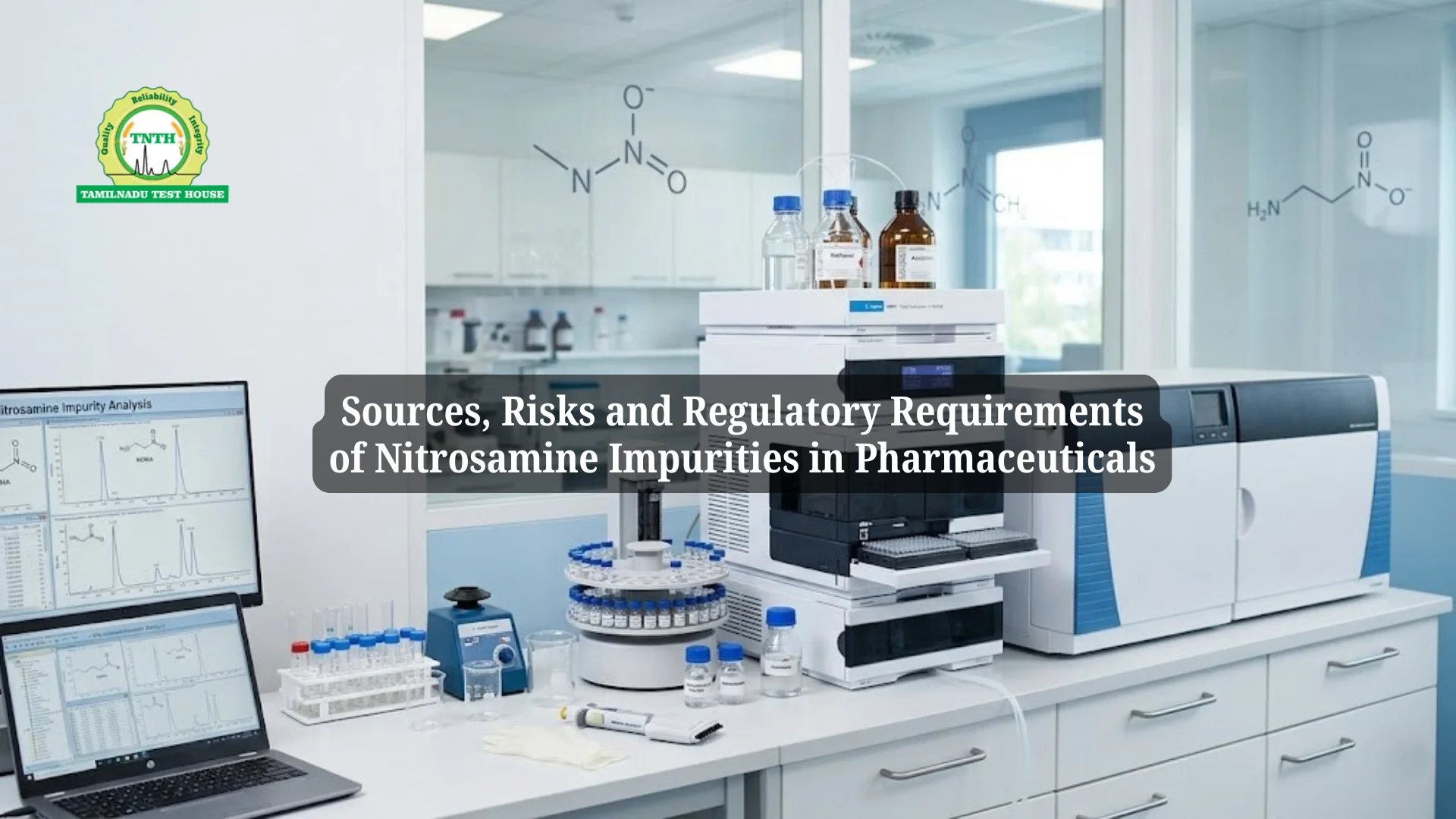
Sources, Risks and Regulatory Requirements of Nitrosamine Impurities in Pharmaceuticals
Nitrosamines have become a serious pharmaceutical quality and regulatory problem since several nitrosamines are regarded as probable human carcinogens. Their identification in pharmaceuticals has resulted in regulators globally raising the bar in terms of expectations on risk assessment, analytical testing, process controls and mitigation techniques.
Pharmaceutical producers, API manufacturers, formulation businesses and contract manufacturers can use nitrosamine impurity analysis to detect and quantify potentially dangerous nitrosamine compounds in pharmaceutical materials and products.
What Are Nitrosamine Impurities?
Nitrosamines are a class of chemicals that can be produced when some amine-containing substances are reacted with nitrosating agents under the right conditions. In pharmaceutical manufacture, these reactions may be caused by raw ingredients, the manufacturing process, solvents, reagents, excipients, water, packaging or storage conditions.
Pharmaceutical nitrosamines include N-nitrosodimethylamine (NDMA) and other compound-specific N-nitrosamines. Some nitrosamines connected to the medication substance, also called NDSRIs, may contain structures related to the active pharmaceutical ingredient itself.
The regulatory concern is mostly with the potential carcinogenic danger of long-term exposure. “Nitrosamines are categorised as potential human carcinogens from animal research, although the risk at the very low doses permitted in medicines is very minimal, the EMA said.
How can Nitrosamine Impurities enter Pharmaceuticals?
Nitrosamines may be formed from a number of sources. Knowledge of these routes is a crucial component of pharmaceutical impurity risk assessment.
1. Manufacturing Process
Certain chemical reactions employed during the manufacture of APIs or medicinal products may provide conditions conducive to nitrosamine formation. The presence of secondary or tertiary amines with nitrosating drugs can raise the potential risk.
Manufacturers consequently have to assess single production stages and not take for granted that a finished product is free from nitrosamine risk.
2. Raw materials and Raw starting materials
Raw materials, intermediates, reagents, solvents and other industrial inputs might contribute nitrosamine precursors or contaminants.
Thus, supplier certification and proper raw-material assessment can be part of a comprehensive nitrosamine management approach.
3. Excipients
Certain excipients may include trace impurities or chemical elements that can lead to the development of nitrosamines under certain conditions. This makes the choice and compatibility of excipients critical in the evaluation of medicinal products.
4. Water and Process Conditions
Chemical reactions may be affected by water quality, pH, temperature, and other processing variables. Pharmaceutical makers should evaluate if their manufacturing environment is conducive to conditions in which nitrosamines may occur.
5. Packaging & Storage
The nitrosamine risk is not always restricted to the production step. In a full risk evaluation, the interactions between medicinal chemicals, packaging components and storage conditions may need to be examined.
What is the issue with nitrosamine impurity?
The main issue is the possible long-term carcinogenic risk.
Acceptable intake limits for some nitrosamines have been set by regulatory bodies based on toxicological information and lifetime exposure concerns. EMA rules compel enterprises to take steps to prevent or limit contamination with nitrosamines and to test products if a risk is discovered.
This means that pharmaceutical businesses can no longer afford to consider nitrosamine analysis as a one-off quality-control procedure. Risk assessment and suitable controls may need to be implemented throughout the life cycle.
Importance of Nitrosamine Impurity Analysis
Nitrosamine Impurity Analysis is analytical evidence that may assist pharmaceutical businesses in determining whether the targeted nitrosamines are present and whether the amounts found require additional investigation.
Testing can aid:
- Quality assessment of the pharmaceutical product
- Assessment of APIs and pharmacological substances
- Finished product testing
- Investigations of nitrosamine danger
- Evaluation of suppliers and raw materials
- Studies of manufacturing processes
- Regulatory paperwork
- Investigations of product release and quality
The proper analytical technique relies on the molecule, the matrix, predicted concentration and regulatory needs.
How is nitrosamines testing done?
The measurement of nitrosamines often requires very sensitive analytical techniques since the individual compound regulatory limits might be quite low.
Laboratories may employ advanced chromatographic and mass-spectrometric techniques such as LC-MS/MS or other methods validated for the analytes of interest and the sample matrix.
A typical testing workflow could include:
- Sample collection and identification
- Target nitrosamines selection
- Preparation of samples
- Instrumental analyses
- Identification and Measurement
- Quality control evaluation
- Analytical findings interpretation
- Reporting observed concentrations
The analytical procedure should be suitable for the target substances and sensitive enough to meet the required acceptance requirements.
Nitrosamine Testing and Nitrosamine Risk Assessment
These two things are connected, yet they are not identical.
| Risk Assessments: Nitrosamines | Nitrosamine Analysis |
|---|---|
| Identifies possible sources of nitrosamine production. | Measures nitrosamines in a sample |
| Reviews the production process | Provides analytical solutions |
| Takes into account raw materials and reagents | Assay for the concentration of the detected chemicals |
| Identifies products for further examination. | Verifies probable contaminant |
| Helps define mitigating methods. | Supports control effectiveness validation |
Analytical testing may be needed as the result of a risk assessment, and laboratory testing can give proof of the actual existence and concentration of specified contaminants.
What do regulators expect from pharmaceutical companies?
Regulatory authorities require manufacturers and marketing authorisation holders to adopt a proactive strategy to address the nitrosamine risk.
EMA has requested that businesses assess human medications for probable nitrosamines and test items considered at risk. Companies should also build suitable control measures and, if required, upgrade manufacturing processes.
Likewise, the FDA has provided recommendations on nitrosamine impurity control in human pharmaceuticals, including risk assessment, detection, and mitigation techniques. FDA’s regulatory materials stress detecting circumstances that may introduce nitrosamines and adopting suitable management procedures.
Thus, pharmaceutical businesses should take the nitrosamine risk into consideration within their entire pharmaceutical quality-management plan.
What Pharmaceutical Products Might Need Nitrosamine Assessment?
The risk of nitrosamines is product-specific and driven by factors such as formulation, manufacturing chemistry, raw materials and others. Evaluation of products with possibly relevant amine structures or production conditions may be warranted.
Nitrosamine evaluation may be useful for:
- Active pharmaceutical ingredients and APIs
- Finished pharmaceutical preparations
- Medicines Generic
- Products manufactured under contract
- Pharmaceutical intermediates
- Selection of excipient systems
- Products with changes in manufacturing techniques or vendors
The definition of the relevant scope of evaluation should be based on the consideration of product-specific scientific and regulatory issues.
When Should Nitrosamine Testing Be Considered by Pharmaceutical Manufacturers?
Testing might be considered in situations where a risk assessment has identified a possible channel for nitrosamine production or contamination.
It can also be useful in cases where:
- Manufacturing processes change.
- Raw material providers are changing
- Additional new starting materials
- A novel formulation is created
- Additional data requested by a regulatory authority
- Unexpected impurities detection
- Variation in process parameters
- Questions of storage or stability
Early-stage review helps organisations catch possible problems before they become bigger regulatory or product quality problems.
How Can Companies Minimise Nitrosamine Risk?
Nitrosamine risk management usually includes a set of complementary measures and not just depending on analytical tests.
Companies may consider:
- Process review: Review the manufacturing reactions and identify any relevant paths for nitrosation.
- Raw-material control: Assess suppliers, starting materials, reagents, solvents, and other inputs.
- Optimisation of chemical processes: Change process conditions or materials, when applicable, to minimise the risk of nitrosamine production.
- Analytical monitoring: Perform sensitivity testing if risk assessment suggests testing is needed.
- Supplier management: Have appropriate nitrosamine considerations included in supplier qualification and monitoring.
- Continuous review: When there are substantial changes in manufacturing, formulation, suppliers or processes, re-evaluate the nitrosamine risk.
Nitrosamine Impurity Frequently Asked Questions
1. What is a nitrosamine impurity test?
Nitrosamine impurity testing is the laboratory analysis of pharmaceutical samples to detect and quantify certain nitrosamine chemicals at potentially extremely low levels.
2. What are NDSRIs?
NDSRIs are nitrosamine-related impurities of the drug material. NDSRIs can be structurally connected to the active medicinal ingredient, unlike some minor nitrosamines that may arise from production inputs and so require product-specific attention.
3. What analytical methods are employed for nitrosamine analysis?
Highly sensitive chromatographic techniques with mass spectrometric detection, such as LC-MS/MS, may be used depending on the target nitrosamine, sample matrix, method requirements and appropriate regulatory expectations.
4. Are laboratory tests the same as a risk assessment of nitrosamines?
No. Risk assessment looks at the potential for nitrosamines to produce or enter a product. Laboratory testing offers analytical evidence for the presence and concentration of targeted nitrosamines.
Selecting a Laboratory for Nitrosamine Impurities Testing
Pharmaceutical nitrosamines may require detection at extremely low concentrations, and laboratories should have proper analytical skills, competent personnel, suitable instrumentation, and quality-control methods.
When choosing a testing laboratory, pharmaceutical companies should take into account the following:
- Related analytics capabilities
- Analytical technique sensitivity and selectivity
- Experience in pharmaceutical matrices
- Quality systems appropriate
- Validation or Verification of Methods as Applicable
- Clear analytical reporting.
- Knowledge of relevant regulatory standards
Tamilnadu Test House offers Nitrosamine Impurity Analysis services to pharmaceutical businesses looking for laboratory support to evaluate specific nitrosamine impurities in relevant pharmaceutical samples.
Learn more about Nitrosamine Impurity Analysis service.
Conclusion
Nitrosamines are an essential pharmaceutical quality and regulatory consideration. Possible formation can be caused by manufacturing procedures, raw materials, chemical reactions, formulation components and other conditions of product or storage.
Therefore, pharmaceutical businesses should integrate risk assessment, process controls, supplier management and proper Nitrosamine Impurities Analysis rather than depending on a single quality-control method.
Manufacturers can use a scientifically designed testing technique to pinpoint specific nitrosamines, evaluate hazards, aid quality investigations, and implement suitable pharmaceutical quality controls.
As regulatory requirements continue to develop, proactive nitrosamine risk management can help pharmaceutical firms make informed decisions about product quality and regulatory compliance.